Dinesh Jinjala

09Personal project

SQLite Graph Accelerator

Author, open source

A SQLite extension I wrote in Rust that runs bounded graph traversals and shortest-path queries over the tables you already have.

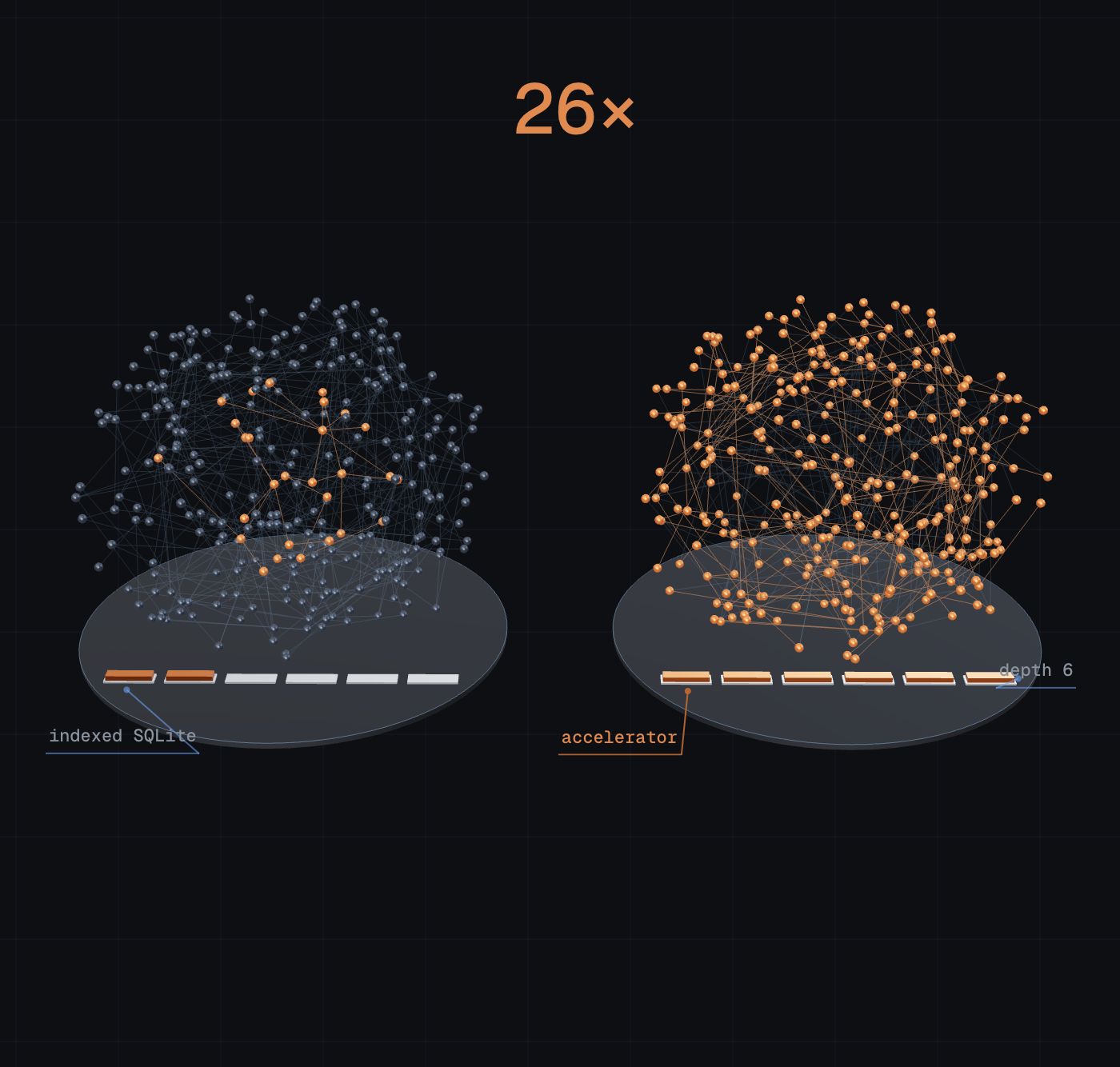
26×
faster than indexed SQLite at depth 6
508K edges
benchmark graph (SNAP soc-Epinions1)
0
data migration: it reads your existing tables

Rust / SQLite / Graph algorithms
Problem

Many applications already store relationships in SQLite as foreign keys, but deep multi-hop traversals get slow in plain indexed SQL. Moving the data into a separate graph database means a second system to keep in sync.

Approach

  • I built a loadable SQLite extension in Rust that discovers existing foreign keys and treats them as graph edges, so no data moves.
  • Reads use a validated compressed sparse row (CSR) sidecar plus a small write overlay, and fall back to indexed SQL whenever the sidecar is stale, so SQLite stays the source of truth.
  • SQL table functions cover neighbors, BFS and DFS traversal with filters, shortest path and weighted cheapest path.
  • Every query is bounded by rows, depth, visited nodes and frontier size, and reports whether it was truncated and which backend served it.
  • It is usable from Python, Node, Go and Rust, and the repo includes fuzz targets and numbered design-decision records.

Architecture

  1. SQLite tables
  2. FK discovery
  3. CSR sidecar
  4. Freshness check
  5. Traversal or SQL fallback
  6. Bounded result

Outcome

On the SNAP soc-Epinions1 graph (75,879 nodes, 508,837 edges), BFS was 4.7× faster than indexed SQLite at depth 4 and 26× faster at depth 6. The trade-offs: one-hop queries are no faster, and writes cost 3 to 10% more.

What I learnedA fast path is only safe with a correct fallback. Checking freshness on every query and dropping to SQL keeps results right when the sidecar lags behind writes.

Building something like this?

Tell me about it