Dinesh Jinjala

03A multi-tenant Pharma Manufacturing Analytics SaaS

AI Agent Platform & MCP Gateway

Architect and developer

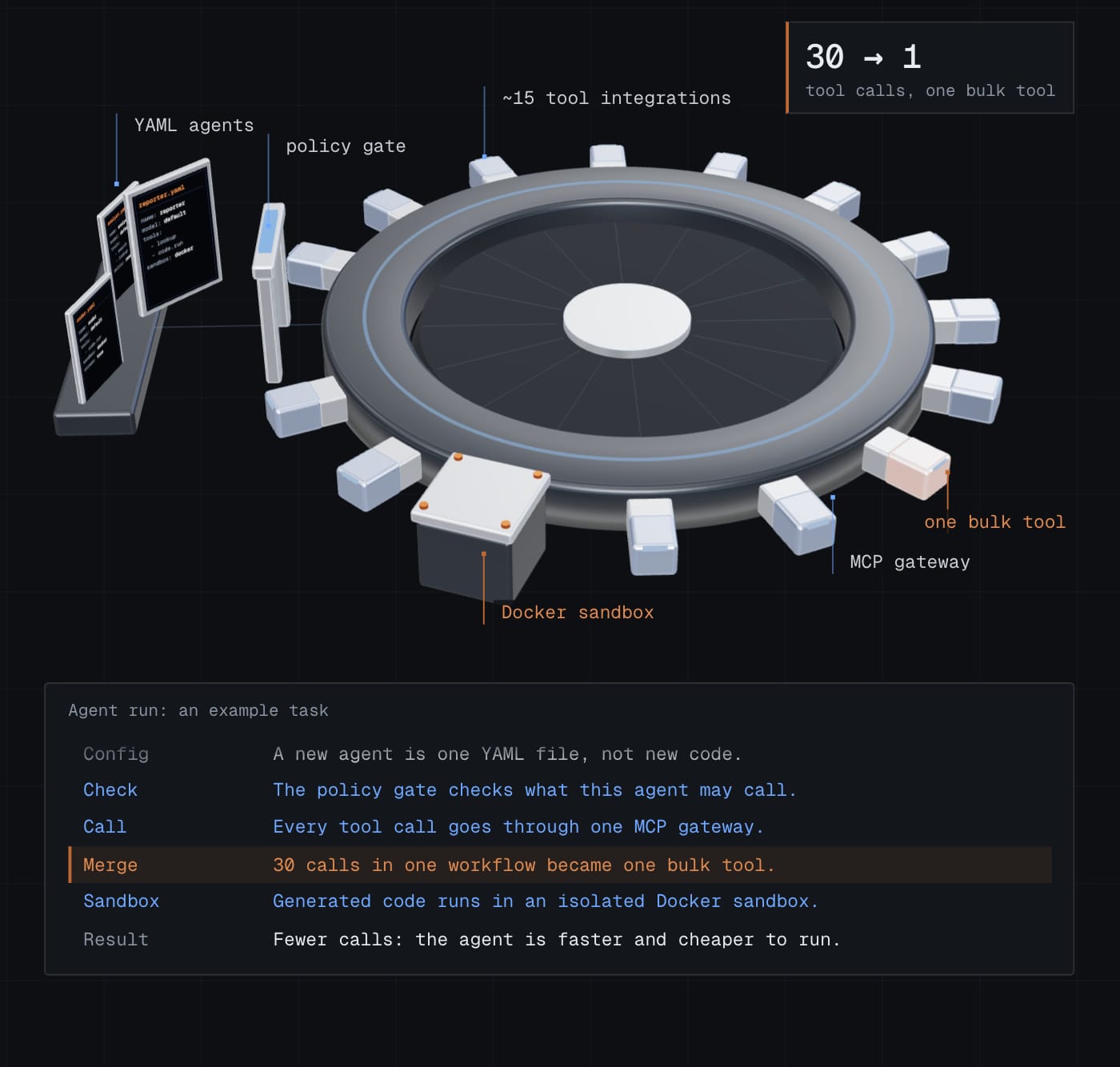
I designed and built a platform where a new AI agent is a configuration file, not new code. Every tool call passes through one governed MCP gateway, and generated code runs in an isolated sandbox. Consolidating tools made agents faster and cheaper to run.

~15
tool integrations behind one gateway
30 → 1
tool calls in one workflow, after I replaced them with one bulk tool
Sandboxed
generated code runs in an isolated container

Python / MCP / Docker / YAML
Problem

Every new agent needed custom code, and nothing controlled in one place what an agent could reach. Teams needed agents they could create quickly and that security could audit.

Approach

  • I designed an SDK where an agent is a short YAML definition of its model, tools and limits.
  • All tool access goes through one MCP gateway that checks each call against the agent's permissions, deny by default.
  • Built-in guardrails stop runaway loops and cap time and cost per run.
  • Generated code runs in an isolated container, and results stream to the user live.

Architecture

  1. YAML agent
  2. Agent loop
  3. MCP gateway
  4. Tool integrations
  5. Sandbox
  6. Streamed result

Outcome

Teams add agents through configuration instead of new code, and every tool call passes the same security checks. In one compliance-reporting agent, one bulk tool replaced about 30 separate calls, which made it faster and cheaper to run.

What I learnedI compared a custom SDK with LangGraph before building. The custom SDK won because it gave us tighter control over security with less to maintain.

Building something like this?

Tell me about it